

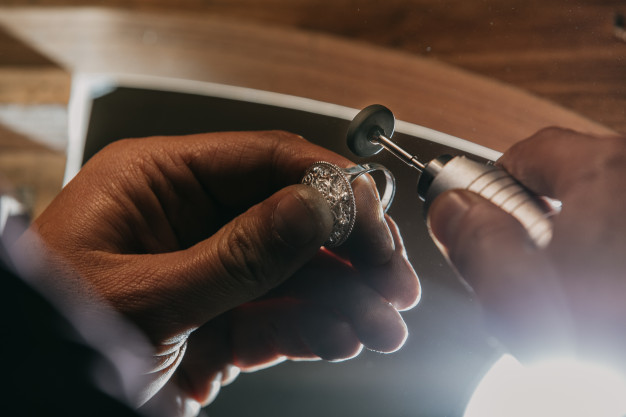
People across the world are growing more and more conscious about their looks with each passing day. They are becoming increasingly picky about their outfits and the jewelleries that complement them. So, there is a great pressure building up among the jewellery designers to create exceptional pieces that will speak to the buyers. The job of a jewellery designer is to create unique designs and work on the intricate details of the jewellery pieces. Consumers want their jewellery pieces to stand out in the crowd and the designers have to master the techniques and mechanisms involved in jewellery designing to excel in this competitive profession. Here are some principles of designing that are essential for jewellery designing:
Balance is the key to succeed in the jewellery designing field. The designers must know how to distribute the designs throughout a jewellery piece. Balance can be achieved by three ways of distribution, i.e. symmetric, asymmetric and radical distribution. Symmetric distribution is when all the elements of the jewellery piece are evenly distributed whereas asymmetric distribution is when the designer places the elements in no specific pattern and plays around with the arrangement to create an unique jewellery. Radical balance has one centre of attention with other elements placed in a circular way.
There is always one part of a jewellery that catches the attention of the viewers and that part is known as the focal point. Designers add a distinct feature to their jewellery pieces that instantly grabs everyone’s attention. One technique of creating a focal point is adding a pop of colour to a jewellery. That colour element will be the centre of attention and will be supported by other elements. The jewellery designs have to visualise their designs on the customer’s perspective to create unique pieces.
Jewellery designers tend to use opposing colours on the colour wheel together to give the design a more prominent look. They choose the colours that complement each other to give the jewellery pieces a pop. They add a diversity to the jewellery designs and attract more customers. Colour combinations like black and white are a classic example of contrast colours. Other colour pairs like lime green and pink, or violet and yellow, etc.
When you look at the detailing of jewellery pieces, you take a look from one side to another as there is a constant path for you to look at. The jewellery designers use techniques like repetition, rhythm and action to create the movement feature. Repetition refers to placing the elements again and again in a constant pattern. Rhythm technique is opted by adding patterns in the jewellery that are a little bit complex like colour contrasting, using different shapes and sizes to give the viewer a variety of elements to look at. Action, on the other hand, refers to playing around with different elements all at the same time.
Jewellery designing is a complex process and can go wrong even with one simple mistake. Stay focused while designing jewellery pieces as one wrong placement or proportion will negatively impact the entire design. Assess every feature including the shape, size, colour of the elements. For more accuracy, have a proper visualisation of the end product so that the whole making process will be easier.
The only way to gain name and fame in jewellery designing is creating pieces that stand out. Designers are advised to experiment and play with different kinds of elements of a variety of sizes, shapes, quantity and colours.If you are planning to take up jewellery designing as a career prospect, you need to take formal training first. JD institute of fashion technology brings you an opportunity to learn essential skills and techniques of jewellery designing along with understanding of the job demands in the professional field in a short span of time. We offer jewellery designing courses for all the designing aspirants who wish to become successful in the field.
 Design Blogs
 Watch on youtube


 Downloads

Copyright © 2025 JD Institute of Fashion. All Right Reserved
Designed by




 Quick Menu