

Apply Now

Author Archive

Steps in The Fashion Designing Process

Tuesday, April 27th, 2021

If you have been guilty of daydreaming about starting your own fashion label, you are not alone! Many budding designers aspire to do this but are filled with countless questions regarding how to go about it. In an industry that is continuously evolving, as a designer, you are expected to innovate and understand the needs of the market seasonally. Because the public always wants something new, designers have to put their best foot forward to incorporate fresh inspiration into their collections. 

So let’s take a look at the stepwise process of how an idea becomes a finished product in fashion designing.

  • Step 1: Following the Directives

Directives are a set of guidelines or a brief that helps you get an idea of what is expected from the product. It can be given by your fashion designing course teacher, by a company or a client. You can also set yourself a brief! But a brief must always be specific and consider many things like the occasion and season, which impacts the fabric you will choose. You can mention your muse, the customer, your target market, the fabric and material, the costing and ultimately, the practical outcomes.

  • Step 2: Research, Research, and More Research!

All good designs start with research as it is the only way to make sure your ideas are original and do not imitate past designs. It also helps you discover new things from where you can get inspiration and form a coherent idea of your design. You can follow a simple formula on the two types of research for your designing process. First is gathering the materials like fabrics and fastenings, which are the tangible elements of your collection. The second is finding a concept and visual inspiration for your work to set your design apart from others. 

Your research should be broad and in-depth and must include many categories, such as deciding the structure and shape of your product. This will give you a practical approach as to how your item would be constructed, whether it is a shoe, garment or accessory. Other things to consider are the colour, texture and prints on the fabric. The remaining details can come from the inspiration sources in your research, like historical and cultural references and contemporary trends. When you have enough concepts and ideas for your project, start brainstorming and putting them on paper by creating a mind map and making sense of them using imagery.

  • Step 3: Choose a Concept or Theme

Your theme needs to go along with the demands of your brief. Try to pack your design with your actual interests and let your personality shine. This will transform the nerve-racking process of designing into a fun one! You can tell a story through your collection. You could also base it purely on visual sources which come together in a common thread. Another way to go is abstract, where you choose an unrelated description or word and translate it into a series of ideas. You should include both primary and secondary sources of research when you make up a theme. Primary sources include personal findings and experiences, whereas secondary sources consist of information received by other people and sources, like books or the internet.

  • Step 4: Where to Get Your Research Material From?

The internet is one of the best options to get access to information and seller contacts worldwide. You can also get to know about the market trends and latest technologies from here. You can identify dozens of sources for research only if you stop and notice them. The film, theatre and music are popular starting points. You can also gain many perspectives by looking at other countries and cultures, catwalk trends, and sifting through magazines. Visiting art museums and galleries and vintage shops, and flea markets are sure to fuel your research with a plethora of vibrant ideas and inspirations.

  • Step 5: Compiling and Analysing Your Research

Compile your work in a sketchbook and use it as a notebook to keep track of your observations for the upcoming collection. You will undoubtedly practice your drawing skills in your sketchbook. Concentrate on all or part of the objects you’re drawing to understand better how they’re shaped and made. You can make a collage to compile your research, giving you further ideas for design and texture. Or you could use juxtaposition, which is a method to put together two different things that share at least some similarities. The more you deconstruct your research, the more variety of ideas you will get! Cross-referencing and creating a mood board are also popular ways for compilation. 

Your analysis can take shape in the form of drawing shapes from your sources and experimenting with details for construction and linear drawings. Consider new ideas for pattern, texture and embellishments in your drawings.

  • Step 6: Design!

The most exciting step of the process is actually designing and coming up with a final sketch from your scattered ideas. There are several solid techniques to jump from research to design. The first is the model and drape method, where you try out new shapes and structures by draping fabric onto a mannequin. If you are a new designer, you should try out the second method of collaged research on a drawn figure. In this, you paste the photocopies of your researched material onto a front view drawing of fashion figures. You can get a clear idea of silhouettes and shapes on the body with this method. The third is making a photomontage with drapery, which is essentially a combination of the first two methods. The images used for the collage are from draping experiments on the mannequin. Several design elements like colour, fabric, silhouette, print and embellishment, historical references, and market trends to look out for before chalking out the final design.

You have been very patient on this journey of understanding the designing process and should be rewarded with the fulfilment of your designing dream! Go through our website for excellent courses like Bsc Fashion Designing to get a head start on your fashion designing career.
You Need to Know These Things Before Becoming a Costume Designer

Monday, April 26th, 2021

Who is a costume designer?

A costume designer creates costumes for movies, stage productions, and television shows. The costume designer’s job is to design, among other items, the characters’ outfits/costumes and to balance the scenes with texture and colour. The costume designer collaborates with the producer, scenery designer, lighting designer, sound designer, and other creative team members. Hair Stylists, wig masters, and makeup artists can also work with costume designers. The role is different in the European theatre, where the theatre designer is responsible for both costume and scenic elements. Designers usually use the visual design of garments and accessories to enhance a character’s personality and construct an unfolding storey of colour, shifting social status, or period. Within the director’s vision, they have the ability to distort or improve the body. The designer must make certain that the designs allow the actor to move as required by the role.

Becoming a costume designer is not that easy as it sounds, however here are some tips by JD Institute which will help you in your journey:

  • You should pester everybody you know to find work, and I mean everybody: Most people get their first job by networking and essentially pestering everyone they meet before someone breaks down and introduces them to someone in the industry.
  • The work entails more study than it does fashion: You must be able to design clothing, but most importantly, you must understand who wears them and why. If you’re working on a film set in France at the turn of the century, you’ll need to know exactly what people wore and integrate it into your designs. My designs for Marvel’s Agents of S.H.I.E.L.D., a superhero drama, must provide every aspect of the characters’ abilities and personalities.
  • Your best friends will be the writers: You’ll collaborate closely with the authors to ensure that the characters can be identified based on their attire. When you get the script, sometimes the costume summary is right there on the list, and it’s your responsibility to help bring it to life. There are some current designs from the original Marvel comics for Agents of S.H.I.E.L.D.; for new characters, you can rely on the writers to have insight into who the character is so you can create a costume that makes sense.
  • You must be able to work with various designs: You don’t want to be labelled, so look for chances where someone can take a chance on you designing for a different genre. After working on a superhero film, it would be fantastic to work on anything like Downton Abbey.
  • It’s easier to come up with a new superhero costume or a period-specific outfit than it is to dress someone who is supposed to be alive today: The superhero suits are a lot of fun, but the real challenge is coming up with believable civilian clothes that still represent who the character is. You must balance the character arc in the script and tell a storey with the clothing, which can be more difficult than coming up with a cool, flashy outfit.
  • It’s a really “behind the scenes” career: This isn’t the glitz and glamour of a Hollywood career if that’s what you’re looking for. You usually arrive at the office between 7:30 and 8 a.m. and leave between 7:30 and 8 p.m. Every day, you’re in the office; sometimes, you’re on set, fitting the characters or assisting with the establishing scenes. The majority of costume designers aren’t well-known, so this isn’t the job for you if you don’t mind working long hours for the sake of the company display.
  • The days are long, and the work dictates how much time you have off: You work 12-hour days much of the time, but it can be much longer at times. The good news is that it won’t last indefinitely. For example, each season consists of 22 episodes on a show, followed by a two-month hiatus during which you can relax. It’s akin to a “summer holiday.” That’s when you go on vacation, visit friends and family, or unwind from the season.
  • You need to be willing to take any kind of risk: If you really want to succeed, you must be willing to take chances in entering the industry and in your own designs. The best way to stand out is to bring something new to the table, so if you come up with a crazy idea, go with it.

To become a costume designer, you will need education or the right type of training, which J.D. Institute Of Fashion Technology provides with its fashion designing courses such as BSc fashion designing and others. With each course being industry-based, students are prepared for the real world ahead of time, making it one of the best options to consider for fashion design in India. Due to their exemplary contribution to education, J.D. Institute has been awarded with various token of recognition such as the international glory award, the times’ power icon award, leaders in education award, best skill learning for fashion design in India at the Indian Education Awards and many more. Candidates are chosen based on their technical or artistic abilities as calculated by a department-developed general aptitude test (G.A.T.). Following graduation, the J.D. council will assist you in making contact with the college and other students, as well as offering useful guidance. It symbolizes the organization’s goal of assisting participants in expanding their business potential by offering a well-organized, supportive, and qualified referral network that enables them to form productive and long-term relationships with quality industry professionals. Enroll right now!

Things You Must Know to Become a Costume Designer

Monday, April 26th, 2021

Costume designers carry our favourite movie characters to life in their clothing, from Dorothy’s Indiana Jones’ well-worn fedora to ruby slippers. You might be a natural for this crucial production job if you want to do more than just watch fantastic characters on screen, if you’re a go-getter who enjoys storytelling, collaborating, designing, studying, and, of course, clothing. Continue reading to learn what there is to know about getting started in costume design and wardrobe.

What is the Role of a Costume Designer?

The clothing and accessories worn by the characters in a film, series, or theatre production are planned and created by a costume designer.

Costume designers, according to legendary costume designer Edith Head, “create the illusion of turning actors into something they are not.” We want people to assume that every time they see a performer on television, he [or she] transforms into a new person.

A costume designer’s job is to visually communicate who a character is through their clothing, to put it another way. Claire Anderson, the costume designer, says, “I am responsible for creating the visual identity of the character from the page to a real-life portrayal of dressed people.” “You can always sort of tell who people are [by what they wear] because we’re all in groups, we all belong to a community or a class…. you can always sort of tell who people are [by what they wear] because we’re all in tribes, we all belong to a group or a class.”

What Does a Day in the Life of a Costume Designer Entail?

A costume designer’s day varies greatly depending on where they are in the production.

There’s no getting around it: working as a costume designer is a long and exhausting task. From the beginning of pre-production, when they’re devouring the script, taking notes, and evaluating the storey, sound, and atmosphere, it’s all hands on deck to the end of production. Though a costume designer’s job is theoretically complete once the cameras start rolling, they’re still on call—and usually on set during production: Molly Rogers, costume designer for “Sex and the City,” “Ugly Betty,” and “The Devil Wears Prada,” says that “every day you need to use the costume breakdown [to] lay out the clothes you have been planning” for the scenes being filmed.

What is the Procedure for Creating Film Costumes?

Until creating and constructing the looks, costume designers review the script, consult with the producer, study recent fashion history and trends, and compile visual references.

The process starts on the list, the Coen brothers’ go-to costume planner, Mary Zophres, says. “[My job] entails reading and interpreting the document. You’re first and foremost serving the script and the director’s vision.”

Following script review, the director is faced with research (especially sketches and mood boards (if the project is set in a specific time period). “I spend the most time with the director and the actors, followed by the crew, production design, and cinematography,” Zophres says. “Sound and the locations department come into play later in the process.”

After their ideas have been approved, costume designers must track down and/or create every shirt, dress, necklace, and every single actor wore a hat. in the production—all while ensuring that the costumes aid the actors in better understanding their roles.

When an actor comes into a fitting, you’re there to help them find the right character,” says Julian Day, an Oscar-winning costume designer. “It’s always very complimentary when they say, ‘I fully understand my character now,’ and you want to do that.”

What is the Best Way to Get Started as a Costume Designer?

There’s no better place to start than the bottom when it comes to showing business.

The most important thing you can do, Cristina Spiridakis, costume designer on HBO’s “High Maintenance,” is “Begin by working as a PA assistant and seeing as many costume designers as possible.” Being a costume PA is extremely difficult to work, requiring a great deal of physical exertion, however you get out of it what you put in… Work hard, learn your trade, and rise through the ranks.”

Gene Lakin, a costume designer and fashion design professor at Pratt Institute, agrees. “It would be lovely to say, ‘Here are ten things you can do to become a costume designer,’ but that isn’t how it works. However, I always tell them, “Always say yes.” If a chance arises, seize it, go for it, and give it a shot. You’ll never know if you don’t try.”

Alternatively, take a page from Oscar winner Ruth E. Carter’s book and begin in the theatre. “Working in the theatre is simpler, and it provides a perfect foundation for characterization, script breakdown, and knowing the actors,” she says. “You can see how [the clothes] influence the viewer right away. The reaction is audible. People aren’t joking because I can’t hear them. in movies until I see them [in theatres]. It’s a fantastic place to practise. That’s how I found out. It may not have the glitz and glitter of Hollywood, but I believe it is a true representation of the art of costume design.”

What Type of Training Do I Need to Become a Costume Designer?

To become a costume designer, education or the right type of training plays a huge role. JD Institute Of Fashion technology provides you with fashion designing courses such as BSc fashion designing etc. With each course being industry-based, the students are ready for the real world beforehand, which makes it one of the best options to consider for fashion design in India. It reflects a legacy of 32 years, record-breaking placement of 99%, and a vision to provide all the external factors like a resource library, infrastructure, etc., to its students so that no external factor acts as a barrier in the journey towards success for their students. Enroll now!

Best Photo Editing Apps for Professional Photographers

Sunday, April 25th, 2021

Photographers are still on the lookout for the right shot. With smartphone cameras now providing excellent optics for capturing high-resolution, sharp results, cell phones are now used to capture a large number of photographs. There are a plethora of free and paid photo apps available now, ranging from simple camera and sharing apps to image processing software with all the bells and whistles apps that allow you to better shoot, edit, and organise images on your mobile devices.

The question is, which photo apps are worth your time and can help you get great results while on the go?. Don’t worry, we have got you covered, JD Institute is here with some of the best photo editing apps for a professional photographer:

  • VSCO

VSCO is a photo-sharing tool in addition to being one of the best photo-editing applications. VSCO is one of the best iPhone photography applications, with a fantastic 3-in-1 camera, social media, and photo app. Unlike Instagram, where you can find people from all walks of life, VSCO has a dedicated group of photographers.

VSCO’s intuitive design is instantly apparent – the main menu is clean and clear, and the tools are built with plain, easy-to-understand icons.

Its Main Features Are:

  • The features of the VSCO camera are impressive. VSCO also has built-in professional camera software that can take manual photos. You can change the focus and aperture, select one of three flash modes, allow gridlines for a balanced composition, and change the interface’s colour. VSCO also includes a built-in camera that you can manually configure and use, including shutter speed, ISO, white balance, and manual focus.
  • VSCO is a photography app that allows you to apply presets or use manual adjustment tools. VSCO has a total of ten presets that can be applied to your images quickly and easily. You can also edit your images to give them an “old film” look by adjusting the colour and exposure.
  • However, if you’re serious about editing, you can use manual software. Crop, exposure, transparency, contrast, sharpen, straighten, saturation, and shadow save are some of the adjustment tools available.
  • Instasize

Instasize is the photo-editing bestie you didn’t realise you wanted. It’s no wonder that Instasize has been dubbed the “all-in-one” photo editing software because of its extensive feature set. The software, which supports both IOS and Android, includes filters, resizing solutions, border/photo frame sets, retouching tools, a text editor, video editing capability, and more are included.

Instasize is simple to use and navigate, thanks to its intuitive nature. Beautiful edits are only a single tap away, whether you’re a first-time photo editor or a full-time beauty blogger.

Main Features:

  • There are over 100 filters that will instantly improve any picture.
  • Stories, posters, and other media have cropping options for fast resizing.
  • There are more than ten photo editing resources available (brightness, contrast, sharpness, and more)
  • There are six retouching tools in total (whitening agent, blemish remover, radiance booster, and more)
  • 30+ border packs to help you personalise your edits even further.
  • Colour correction, video editing before sharing on social media; Grid planner, rate your video content before posting your filtered photos to Instagram, shuffle them around. Uploading to Instagram, and schedule your feed!
  • Choose from 20+ fonts to add your voice to every edit in the text editor.

Movavi Perverse

Movavi Picverse is a photo-editing programme that even the most inexperienced users can use to produce professional-looking results. You’ll appreciate how simple the GUI is to use and how many choices it provides. To help you create atmospheric images, the app heavily relies on colour-grading tools and artistic effects. You can also use the blurring feature to mask an unappealing backdrop or add a sense of mystery to your portraits.

With cropping presets for Instagram, Facebook, Pinterest, Snapchat, and Twitter and other social media platforms and other universal aspect ratio formats, Movavi Picverse makes it simple to adapt your images for social media (3:4, 16:9, etc.).

Main Features:

  • Over 300 creative colour filters are chosen, including sepia, black-and-white, gradient, and pop-art effects.
  • There are over 400 effects and textures to give your images depth.
  • Cropping, rotating, and flipping tools are used to change the composition of the image.
  • Brightness, contrast, exposure, saturation, and temperature are all manual colour-grading instruments.
  • Enhancing the sharpness of blurry images

Google Snapseed

Snapseed is a Google-developed professional photo editing software. Snapseed is the app to download if you’re looking for a Photoshop-like photography app. This software is also known for being able to edit RAW files. Since smartphones can now shoot RAW photos, it’s also essential to edit them properly in a good editing app. Though it lacks some of Photoshop’s features and functions, most of its controls and editing process are quite similar.

Main Features:

  • Snapseed’s main function is to edit photos, but it also allows you to take photos from your iPhone or iPad.
  • Snapseed’s main function is to edit photos, but it also allows you to take photos from your iPhone or iPad.
  • Snapseed may have a camera limitation, but it’s jam-packed with editing features. It has 29 filters and software for fine-tuning photos, face poses, glamour glow, and double exposure, among other things.
  • It does not have a particular social network when it comes to social sharing.
  • The only drawback to editing in Snapseed is its gesture-based tools, which can be difficult to master for newcomers.

If you are interested in making a career out of photography, the right type of training or education forms a major role. JD Institute OF Fashion technology is one of the best institutes providing photography courses like a diploma in photography or bachelor of photography etc., with each course being industry-based. The students are selected based on GAT or general aptitude test to assess the creative abilities of the candidates. Enroll now!

A Complete List Of Photography Genres by JD Institute

Saturday, April 24th, 2021

Building a career in the field you are interested in is an amazing thing. If you are planning to start your career in the photography stream, you should read this post. Here is a list of 33 photography genres that JD institute offers in their insightful photography courses. It’s better if you know the different genres that you can try on in the photography niche. If you are wondering which kind of photographer you need to become, this post might help you. So keep scrolling.

Types of photography:

  • Double exposure photography

Double exposure photography is based on developing the surreal picture by combining two other concepts. In this type of photography, you will work on different layers of the images to build your unique one.

  • Drone/ Aerial photography:

Drone photography is about showing the first-person view of a photograph. It is usually done with the help of an Unmanned Aerial Vehicle (UAV), and it is operated remotely to capture the best view. So, the uniqueness of this photography involves capturing the best first-person perspective.

Apart from being fancy, this photography is used for geographic mapping, precision agriculture, weather forecasting, and many more.

  • Editorial photography

Editorial photographs are bound to tell stories through a single image. Fashion photography falls under the branch of editorial photography. Editorial photos are bound to represent the magazine’s brand without using any text or logo.

  • Documentary photography

Documentary photography is about showing a clear picture of a person’s style or a place or event. It is also known as photojournalism. This genre of photography involves more research to make the proper reflection in the image.

  • Concert photography

As the name indicates, this photography style involves capturing the real emotions of a concert. This kind of photography is much used for live shows and also the pre-recorded ones.

The objective of this photography is to splash out the essence of the vibe happening in the concert.

  • Commercial or product photography

This kind of photography is done for commercial purposes like an advertisement. Here, the photographer only focuses on highlighting the products in the photograph. The commercial use can be anything like for a website or digital ads, or TV advertisements.

  • Black and white photography

The black and white photography focuses on delivering the exact textures, structure, and detail of the picture. This photography focuses on eliminating the distractions of colours.

  • Astrophotography

Astrophotography focuses on capturing aesthetically appealing images of astronomical objects. This focuses on capturing the celestial objects like stars, Moon, Sun, and other astronomical events that are happening.

  • Abstract photography

Abstract photography focuses on developing a new perspective for the image. The key goal is to show up the photographer’s unique perspective in the captured image.

  • Architecture photography

Architecture photography involves capturing amazing pictures of the buildings. These pictures are often taken for commercial purposes.

  • Baby or new-born portrait photography

As the name suggests, photography is for capturing babies. But the key thing needed to be focused on here is to handle patience with babies.

  • Boudoir photography

Boudoir photography is meant to celebrate oneself. So, this photography involves capturing attractive images of people.

  • Fashion photography

Fashion photography is about capturing many words in a single image. You also get a three months diploma in fashion photography from JD institute. Check out JD institute’s fashion photography diploma course now.

  • Event photography

This is a booming genre of photography in recent days. Just like concert photography, here also you need to capture the vibe of the event. But also here, you need to give equal concentration for candids. This involves capturing pictures of weddings, birthday parties, get-together parties, and so on.

  • Fine art photography

Fine art photography is about showing the photographer’s creative perspective on a subject. The objective here is to reflect the photographer’s idea or message through the picture.

  • Photojournalism

Photojournalism is about capturing and collecting images on a specific subject. These images are primarily used in newspapers and magazines.

  • Food/ restaurant photography

Food or restaurant photography focuses on developing attractive images of food and the restaurants. These images are also used for commercial purposes at times for the restaurant.

  • Landscape photography

Landscape photography is about capturing the serene scenes of beautiful nature.

  • Lifestyle photography

Lifestyle photography is about capturing real-life subjects. These kinds of images are mostly used for blogging purposes.

  • Light painting photography

Light painting photography is about capturing the fine movements of light and just showing a pattern.

  • Macro photography

Macro photography is about zooming in a lot to capture an image. These are extremely close-up images that human eyes fail to see.

  • Long exposure photography

Long exposure photography is about capturing cool images of things in motion. Mainly these pictures are meant to blur out the motion stills of the photo.

  • Pet photography

As the name indicates, the photography focuses on capturing the pictures of the pets. But the photographer needs to feel comfortable with them and know how to behave with the animals to take better pictures.

  • Maternity photographs

Maternity photographs are on the current trend. These photographs are meant to capture the happy moments of to-be parents.

  • Real estate photography

Real estate photography is about capturing the best images of commercial spaces like offices and rented houses. This photography is also meant for commercial purposes.

  • Portrait photography

Portrait photography is about capturing the real emotions of people in the images. When compared to days before, now the need for professional photography has boomed.

  • Travel photography

Travel photography is about capturing the essence of a place through its food, architecture, and unique culture. This genre of photography is booming these days on social media and magazines.

  • Underwater photography

Underwater photography is about capturing the coolest images of the things and animals under the water. For this definitely, the photographer needs to dive and swim underwater.

  • Interior photography

Interior photography is about capturing the amazing aesthetics of the interior space. These photographers work keenly with the details of the building.

  • Wildlife photography

Wildlife photography is about capturing the wildlife’s unique beauty. These photographers are the ones who are photos of nature.

  • Surreal photography

Surreal photographs twist reality with a quirky perspective. These images are not authentic, but they are from the perspective of the photographer.

  • Street photography

Street photography is about capturing the exact emotions of people in a public place or a street.

  • Still life photography

Still, life photography is about capturing the creative context of a subject. This involves a lot of photographer’s creativity.

15 Types of Photography for A Professional Photographer

Friday, April 23rd, 2021

Photography is an exciting but highly diverse field. It can be challenging to choose what kind of photography you want to make a living out of when you have so many options! This is one of the most challenging decisions for an amateur photographer when he begins his career. Everything seems doable! But you need to figure out what works best for you in this dynamic arena, where there are several ways to capture an image. There is always something that interests everyone in this stream. That is why we have come up with the 15 most popular types of photography that will make your prospects clear. Although you can find many other ways to earn a living out of photography, all of these are the most lucrative options out there!

Portrait Photography

This is one of the most common types of photography, but one that will allow you to flaunt your expert artistry. People require portraits for almost every sphere of their life, be it newborns, high school photos, and general family photos. Portrait photographers are also in need at workplaces and sought out by models in need of headshots. It is best to work up a good portfolio of quality shots before being recognized for a massive gig!

Wedding Photography 

Wedding photography requires mastery over the craft because you have to be adaptable to the demands of the bride and groom. You must be ready to shoot quality photos day in and day out, in bright outdoors or dimly lit indoor settings. It requires being quick on the feet as you will seldom be given the same pose twice at a wedding! It is a tempting area of photography.

Event Photography

Event Photography is on the same lines as wedding photography, but it involves working in various settings, from workplace gatherings to rock concerts. It is a dynamic option as your work can be used in a variety of ways.

Product Photography

It involves a wide range of options, from food photography for restaurants to capturing jewellery for catalogues. Every product that is marketed requires to be photographed so you will never run out of things to catch! You can set up a tiny photo studio and freelance for people who need still life photographs.

Fine Art Photography

If you are someone with a creative edge, fine art photography is for you. You can create art in photos and display them in galleries, where people can admire your work. It gives you a free hand to explore your photography skills and understand how well you communicate with the audience.

Fashion Photography

It is one of the most glamorous photography jobs and involves capturing the latest styles and trends on the runway. Here, lighting is everything, and the focus is on the model, so you have to work with all the elements so that the finished piece is perfect. You will need to work with fashion designers, makeup artists and an entire crew that makes your photo look flawless. You can get a diploma in photography for this field that will help you create a strong resume. 

Architectural Photography

Attention to detail is the main focus of Architectural photographers. This is because it involves capturing the essence of the building from its foundations to its completion. You need to be careful about subtle details and additional techniques and equipment for the perfect click. Many people involved in real estate also need photos to take properties on the market and pay a handsome amount to get a professional look.

Travel Photography

If you love to travel and would like to get paid for it, this is your best option! As a travel photographer, you get to be a part of various types of photography like landscape, portrait, and wildlife. You can transport your audience to beautiful locations all around the world with your photography skills!

Advertising Photography

This is a commercial area of photography that is highly in demand right now. You will always have different subjects to cover, as you may shoot for billboard ads, do product and fashion photography, or work for a big ad agency. The scope is broad enough for you to take your pick. You can get better at what you do with various photography courses online. Proper expertise in one type of photography always gives you a much better understanding of the other fields.

Photojournalism

If you are someone who is determined about getting the truth out in the form of news, documentaries or magazine photos, photojournalism is for you. It is interesting because your photos make an actual impact on the world. Publications and newspapers are always in need of still images to help tell their story. It majorly involves documenting events as they unfold.

Pet Photography

This is a budding career option for animal lovers. You can do fun outdoor or indoor studio shoots and can build your reputation quite quickly. You might require to discipline your subjects to behave with little treats now and then! Start by volunteering for pet adoption photos and work your way from there!

Sports Photography

It is an excellent gig for sports lovers. You can be part of the action and capture winning shots. Your photos can wind up in newspaper articles, sports magazines and advertising campaigns for the teams.

Aerial Photography

It is a new and upcoming concept of photography that makes use of modern tools. If you are interested in aerial shots using drones, you can try this out. It produces unique and beautiful shots, which is why drones are used in almost all events like weddings and architectural photography.

Scientific Photography

It involves photography required for surveys and studies. Many scientists employ photographers to document new findings and discoveries. It also includes wildlife and aerial photography. You can undoubtedly freelance in this sector and make a successful living.

Stock Photography

If you are interested in all types of photography, you can go for stock photography to sell your images to whoever wants to use them. It benefits from having an extensive catalogue of images for a stock photographer to become a proper expert in the field.

Now that you have a fine understanding of the different types of photography, you can very well choose what suits you the best. Then you can go for professional courses like a bachelor of photography to hone your talent in the right direction. Get in contact with JD Institute to join some amazing courses on fashion designing and photography. To enrol, you need to appear for and clear GAT, which is the general aptitude test for selection for our excellent courses.

What is The Meaning 0f Luxury in Today’s World

Friday, April 23rd, 2021

The concept of luxury and what is perceived as acceptable fashion has been undergoing a rapid change. When you ask ten people what their understanding of luxury is, you are bound to get ten different answers. The reason for this variety in responses is that our notion of luxury is changing. The cultural background and ethnicity of a person also widely influences their perspective of the term. Luxury was previously something utterly different from what it is becoming today. If you are interested in fashion, you can get helpful information about art and style from our website.

The Classic Definition Of Luxury

We know that the basis of something becoming a luxury is that it must be exclusive or conspicuous, not readily available to the general population. In India, especially, luxury is about gaining social recognition, which tells us how society has clouded our judgement. This is why earlier luxury brands only kept in mind the requirements of the rich, whereas now things have changed and more people can afford to live a luxury life. The definition of luxury also varies from person to person and country to country as well. For example, in countries like France and Italy, luxury is a part of their tradition and way of life. Germany equates luxury with functionality and the practical purpose of something, like luxury cars. In Russia and Poland, luxury is solely used to achieve a higher status in society, which also applies to Asian countries like India. 

What Has Changed?

The younger generation of millennials no longer accept this bygone definition of luxury. They are much more practical in their approach towards fashion, which has caused the fashion industry to cave into their demands. Today’s luxury buyers claim that not all luxury purchases must be the most costly, implying that the most luxurious things are not always the most expensive. We are moving actively towards sustainability, and the luxury brands that will support this cause will ultimately survive. Millennials, who are driving luxury demand, are becoming increasingly aware of and interested in environmental issues. As a result, sustainability decisions are affecting their spending habits. If you are also enthralled by this luxury and fashion topic, you should look at the various types of fashion designing courses we offer to broaden your knowledge.

Luxury Is Increasingly Becoming An Experience

When you now think of luxury, it shifts its focus towards becoming an authentic experience and something that gives personal fulfilment. The fashion industry is also reeling from this change and keeping up with these new and personalised fashion demands. You may have noticed that we have started giving more importance to reasonability than just collecting material things. We need whatever we buy to provide us with actual satisfaction and have original value. That is why we are more attracted to natural things or eco-friendly products in harmony with nature. It gives us joy that the product we are using has a story and process behind it, free of cruelty. 

How Has The Fashion Industry Coped Up?

This shift in demand has led to more changes in the fashion world, which has begun rolling out sustainable products like eco-friendly clothing. They claim that these are made from recycled products or in cruelty-free ways, highly appealing to these new-age consumers. Being environmentally friendly has become a new trend, and we are welcoming it with open arms. Today’s high-earning buyers are looking for experiences that help them learn, make themselves stand out, express who they are, and have a purpose beyond comfort and pampering. 

How We Can Help You Make A Change

Suppose you are interested in knowing about the fashion world and would like to enhance your knowledge. In that case, you can check out the various courses available for fashion designing. This will enrich your understanding of what is going in the global fashion scenario. It will also change your outlook on the current fashion trends. We offer a wide range of courses, and we are training students for a successful career in this field. Graduates with a bachelor’s degree in fashion design, apparel design, visual merchandiser, or fashion marketing will pursue careers as fashion designers, textile designers, visual merchandisers, or fashion marketers. It will offer you a one-of-a-kind ability to affect and transform the fashion industry.  Our goal is to teach students how to make unique creations, envision emerging fashion patterns, and think creatively. Our goal is to keep the production practice consistent to move from fashion runways to supermarket shelves seamlessly.

Choose From Different Types of Fashion Designing Courses!

Depending on the institute and area of interest, you can choose from a range of courses. You can check out the entire list of courses on our website and decide what will be best for you. You can also talk to our experts if you need more information or help in determining the course. If you are keen to learn about the fashion industry, like your work profile, the scope of a fashion designer or fashion designer salary, you can get all the answers from our website courses. If you are interested in short-term studies, JD Institute also offers several Diploma courses. To get in, you need some fashion designer qualifications based on which admission are done in top fashion designing colleges. So explore this remarkable career of fashion designing, which is in high demand right now. The fast-changing trends of the fashion world have caused the fashion industry to sky-rocket and led to the opening up of new and inviting career options. Take advantage of this opportunity and apply for one of these fantastic courses!

LUXE TALKS 4.0 – Luxury Aglobal Perspective

Friday, April 23rd, 2021

About

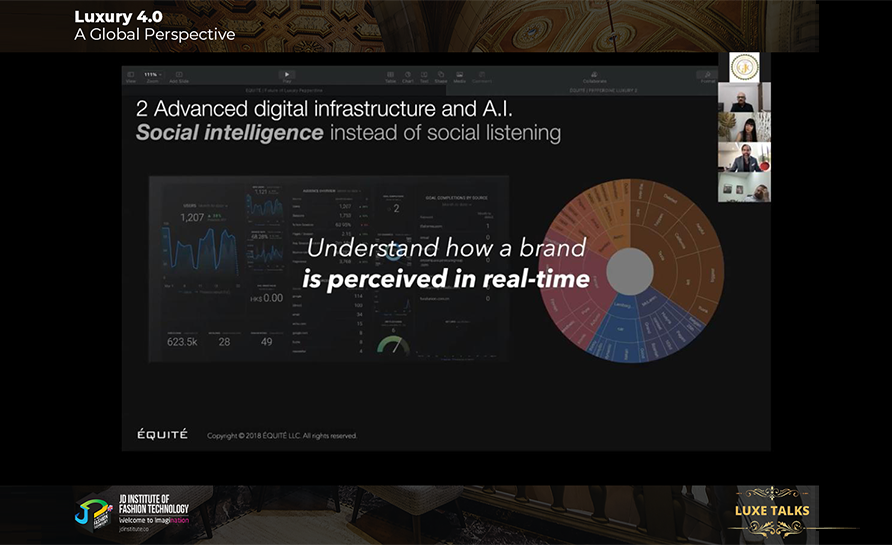
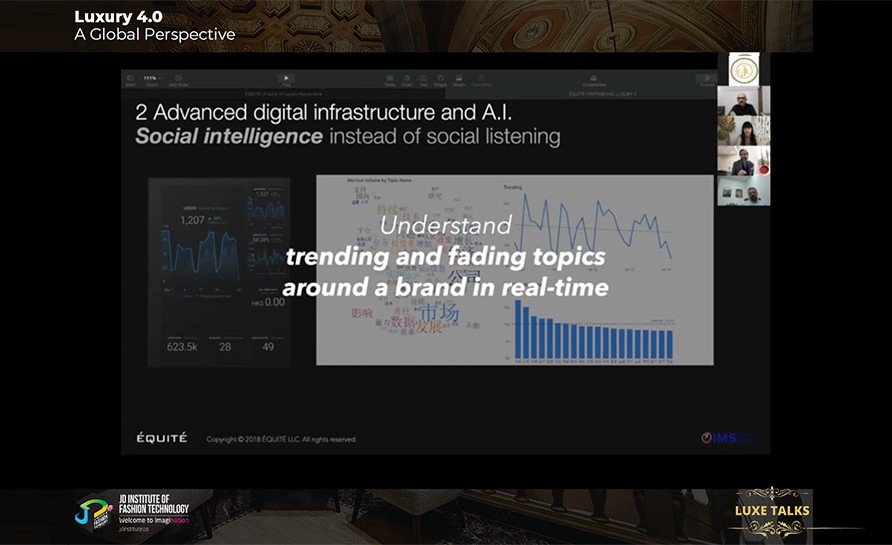
JD institute was happy to support luxe talk. A Global perspective on a digitally connected world and its impact on luxury brands. The objective of this session was to showcase the technological advances and their impact on consumer behavior along with the importance of agility to reach beyond the normal. The session had three experts from the industry as panelists.

Session by Dr. Daniel Langer

First of them to speak was Dr. Daniel Langer who is the Founder & CEO of Equite brands known for brand building and value creation.

The key takeaways from his session were;

• It is essential to invest in brand building through digital marketing spheres as GEN Z are the hardest consumers and highly aware in the market about the product.

• The brands need to think much more in values and entertain the Target Group through great experience. They need to know and build up their content showcasing products for presenting what the brand stands for.

• The need to scrutinize the identity and look for what consumers are looking for.

Session by Mr. Milvin George

Second panelist was Mr. Milvin George who is known for being a passionate style aficionado and having an eye for quality who has worked with top notch luxury brands in the watch industry.

The key takeaways from his session included;

• The need for brands to ponder on questions when a brand should connect with their respective TG and how.

• He shared that digital media and social media gave a pathway to tackle the American Market with his own brand in the picture. The process of considering the budgets to create a plan to advertise the brand that corresponds to the likes of the markets is a crucial aspect.

Session by Ms. Katerina Perez

Third panelist Ms. Katerina Perez, globetrotting jewelry aficionado who has a website dedicated to jewelry and gems shared her insights about the current scenario in the market.

The key takeaways from her session ;

• She detailed how certain elements of design specific for certain markets based on the taste & preference affects the consumer behavior.

• She also said that with the digital world in picture we all are one world now as long as the brand is corresponding to the likes of those potential customers in the market.

• Social media is a great selling tool as long as the brands are bringing value to the posts. How one brand is different from others depends on how they present themselves by sharing visually aesthetic content from Brand’s products.

There was a Q&A round with Ms. Akshra Dalal, director of JD Institute of Fashion Technology which concluded that Luxury doesn’t work in a vacuum and the sessions were really thought provoking with insightful learning outcomes for aspiring designers of tomorrow and existing professionals in industry today.

Panel discussion

Overall this virtual idea exchange forum offered a wide range of perspective for Luxury enthusiasts. The panelists enlightened us with expertise on how to sustain luxury brands in today’s time that corresponds with the global market. JD Institute is happy to be associated with LUXE TALKS for the purpose of educating the aspiring designers and jediiians towards the Luxury Brand designing , marketing and communicating the products created to the right consumers in the right way using their Imagination .

Cool Clothes Designing for a New Generation

Thursday, April 22nd, 2021

Outspoken and idealistic, the most potent tastemakers are straightforward and idealistic. Cameron Laux talks about the gatekeepers who make decisions about what we wear and how we work.

The sole arbiters of fashion taste used to be a limited collection of glossy print publications. Now that style commentators have expanded to countless websites, Instagram posts, and other sources, the role of tastemaker has become more complex – both of which are capturing the interest of people under 35 and eating up advertisement budgets as they go.

There’s the Business of Fashion, or BoF, which began as a simple one-person fashion blog in 2007 and has since evolved into a multifaceted online fashion magazine and consultancy. A sniffle from BoF will send fashion houses into convulsions. Then there’s Highsnobiety, a streetwear website/multimedia brand/branding business (with apparent synergies) that has attained the holy grail in the post-‘legacy-media’ multiverse, becoming a bastion of good taste.

The daily bulletin email from Highsnobiety is primarily about limited-edition sneakers and clothing. Still, it can also include elements of broader cultural and artistic analysis – music, film, fashion, and some dalliance in the arts and design – that weave together to form a kind of lifestyle meta-commentary. The year 2018 was commonly recognised as the year of streetwear’s maturation. Check eBay if you have any doubts: a pair of 1988 Nike Air Jordans is currently on sale for C$42,000 (£24,779), with 341 people’ watching’.

The true storey, though, is the market for limited-edition trainers, T-shirts, jeans, hats, and other items – new or resale – for which many ordinary people can pay exorbitant costs. In this way, the word “street” applies to regular people on the street who have slight yet obsessive taste refinements that enable them to master a wide variety of Pedi.

The rise of designer Virgil Abloh is mainly due to the current importance of streetwear. Abloh is just as ‘street’ as you can get. He first gained notoriety as a collaborator on rapper Kanye West’s Yeezy label, then found his Off-White label. Yeezy had a habit of selling out quickly and then moving onto resale sites, which it still does. At the same time, Off-White gave underground fashionistas fits as they threw their money at each limited-edition ‘release’ of clothes. Over the last year, Virgil Abloh has broken the fashion internet more times and in more ways than anyone else.

Abloh has become the artistic director of Louis Vuitton, a luxury fashion house that is undoubtedly waiting for Abloh to bring some of the market magic to its brand. The pairing makes sense: Abloh’s raunchy anti-aesthetic, which features clashing colours, loud designs, and even louder slogans, branding, and tags, should complement the LV logo, which has become a symbol of wealth. Why not seize the opportunity and run with it? The arbiter of taste is skilled at treading the fine line between elitism and simplicity in terms of style.

In several ways, the idea of riches has become cliched. Those who celebrate it have become taste judges – but not necessarily of ‘good taste. Kris Jenner recently received the Goyard “Rich as it Can Be” suitcase as a Christmas gift from her family. This sparked a debate. It’s also probably ironic, and it’s a lot of fun to figure out. On one level, the slogan implies that only fools care about degrees of wealth or style because of its utter vulgarity. In a way, the entire Kardashian family dedicates their lives to providing their audience with an impeccable, and probably democratic, lack of taste.

Poster Boys

Highsnobiety walks a fine line between elite vulgarity and accessibility, but not too much accessibility. To aid us in this minefield, it has recently released The Incomplete Highsnobiety Guide, a bible of street fashion and culture – because if it were ‘complete,’ Highsnobiety would be the snobbish authority it despises, and its project would be dead. If you happen to be a style nerd or, in Japanese, an otaku, the book defies standards by being stimulating and near basic. It crackles with fascinating countercultural confidence and creativity, even if you aren’t. It’s called a ‘snapshot’ because the street style changes rapidly.

The evolution of street style shows that popular culture is undergoing a metamorphosis and is becoming involved in youth-led radical identity politics. Mark Parker, the CEO of Nike, one of the playground’s big boys, contributes an interview to the Incomplete Guide’s first chapters. (There’s a picture of him with his lips pulled together in a grimace.) Does the 63-year-old seem uneasy?) “Consumers want to know what you stand for as a company,” he says, and he believes it is important to “speak out against inequalities.” In 2018, a Nike ad campaign prominently supported Colin Kaepernick, an American football player who sparked outrage when he refused to stand for the national anthem.

If you want to become a fashion designer, there are various types of fashion designing courses. Education forms a significant step in your journey of success or in bagging a decent fashion designer salary from the starting in this field. JD Institute Of Fashion technology is one of the finest institutes for art and creativity, providing various industry-based courses such as fashion designing or fashion styling. Its students can face the real world confidently. They have won several awards like the international glory award, the leaders in education award and many more for their exemplary contribution towards education and record-breaking placement of 99% with their students working for top companies like Zara, Sabyasachi, etc. and making a name for themselves in their respective fields. Enrol now for this fantastic opportunity!

Train Your Mind for More Creativity in Designing

Thursday, April 22nd, 2021

Lifting weights is an excellent way to gain muscle mass. Do you want to improve your speed? Sprints should be finished. Do you want to be more adaptable? Extend the muscles. Do you want to be more inventive? The concept is the same. Any good, old-fashioned creativity exercises are the perfect way to get those juices going.

Creativity is a muscle that can be exercised. It, too, needs exercise, much like any other muscle. Consider this latest fitness routine if you’re having trouble connecting with your muse:

  • Schedule a block of free creative time

You can’t predict when inspiration will hit. And adding constraints on imagination, such as “I need to design a logo for this client in the next three hours,” may make it difficult to be motivated.

Make time in your schedule just to be imaginative. Consider it your “free gym” time for creativity. Setting aside some time when you’re free to create without any demands, deadlines, or client work relieves some of the burdens and allows new creative ideas to emerge.

Set aside a few hours per week to uninhibitedly pursue your imagination. Also, don’t feel obligated to keep things design-related—anything innovative is appropriate. You may doodle in a notebook or make a rough sketch of a new illustration. Often, get out of your creative comfort zone. Play some songs. Consider enrolling in a movement class. Come up with a stand-up routine. Make every effort to let go and be adventurous without any constraints or aspirations.

  • Set a creativity timer

Strict boundaries may often suffocate imagination. They will, however, often actually inspire creativity.

Set a timer for five to ten minutes and challenge yourself to produce something—a design sketch, a small drawing, a poem, a new concept, or something else you can think of. The tight deadline can encourage you to explore new and exciting avenues for your art.

It’s the equivalent of seeing how many squats you can do in one minute. You’ll drive yourself harder and, in this situation, be more imaginative as you watch the clock tick down.

  • Go for quality over quantity

In the gym, you should always choose consistency over quantity. It’s fantastic to do 100 sit-ups, but you won’t see results if you don’t use the proper form.

When it comes to architecture, though, the reverse may be true. Going for quantity over quality can sometimes be just what you need to get your creative juices flowing.

When working on a single design, it’s easy to get engrossed in the pursuit of perfection, which can stifle innovation. Who will come up with fresh, creative ideas when they’re obsessing over the best line thickness? If you’re having trouble with this, try the 30 Circles exercise. Set a timer for three minutes and draw 30 identical circles on a sheet of paper. Complete as many as you can in the given 3-minute window.

  • Become an idea machine

If you’re a runner, running would be your primary form of exercise. But that doesn’t rule out the use of other forms of exercise, such as interval training, weightlifting, or yoga. Those complementary exercises aren’t just about adding variety to your workout. They’ll improve your running ability by making you quicker, stronger, and more agile.

The same can be said for design. Work the creative muscle with imaginative exercises, but if you want to be your most creative, change it up and include various activities.

Is there one exercise that will give you a lot of bang for your buck? Developing into an idea generator.

Have a new topic every day. They may be work-related, such as “10 undeveloped production strategies” or “10 approaches to find potential customers.” Or something completely unrelated, like “10 suggestions for next summer’s big blockbuster” or “10 technologies that might help dogs interact.” Come up with ten original thoughts with no ifs, and, or buts.

  • Get out of your office and into the world

Treadmills are great, but you need to get outside and run around the forest now and then. Although your office can be a wonderful place to work, sitting at your desk, looking at your computer screen, it’s challenging to find creative inspiration. You must get up and go if you are feeling uninspired. Right now, for example.

And it could happen anywhere. A nearby shopping district (great people-watching! ), an outdoor concert, a park, or your backyard are all excellent options. Whatever fits your needs.

  • Look at something familiar in a new way

You will get bored jogging on the treadmill for 30 minutes every day. However, if you develop new ways to use the treadmill, such as increasing the incline to work your glutes or doing sprint bursts, you’ll find yourself getting excited about your workouts all over again.

You can do the same in your imagination!

Pick a familiar object you use daily and try JP Guilford’s Alternative Uses Test, which he developed in the late 1960s (in the original test, people used a paper clip). Then come up with as many new apps as you can in two minutes.

Suppose you want to be a fashion designer or want to become a fashion designer with a good fashion designer salary. In that case, the first step is to get an education from a respectable institution. JD Institute Of Fashion Technology is one of the best institutes in art or creativity, with a 32-year history. It represents industry-based courses like fashion design, so students are prepared for the real world ahead of time. Candidates are chosen based on their technical or artistic abilities calculated by a department-developed general aptitude test (GAT). Following graduation, the JD council will assist you in making contact with the college and other students and offering helpful guidance. Enlist for a fantastic opportunity

Copyright © 2025 JD Institute of Fashion. All Right Reserved

Designed by Red Lemon

Whatsapp icon
Apply Now
Enquire
Quick Enquiry